
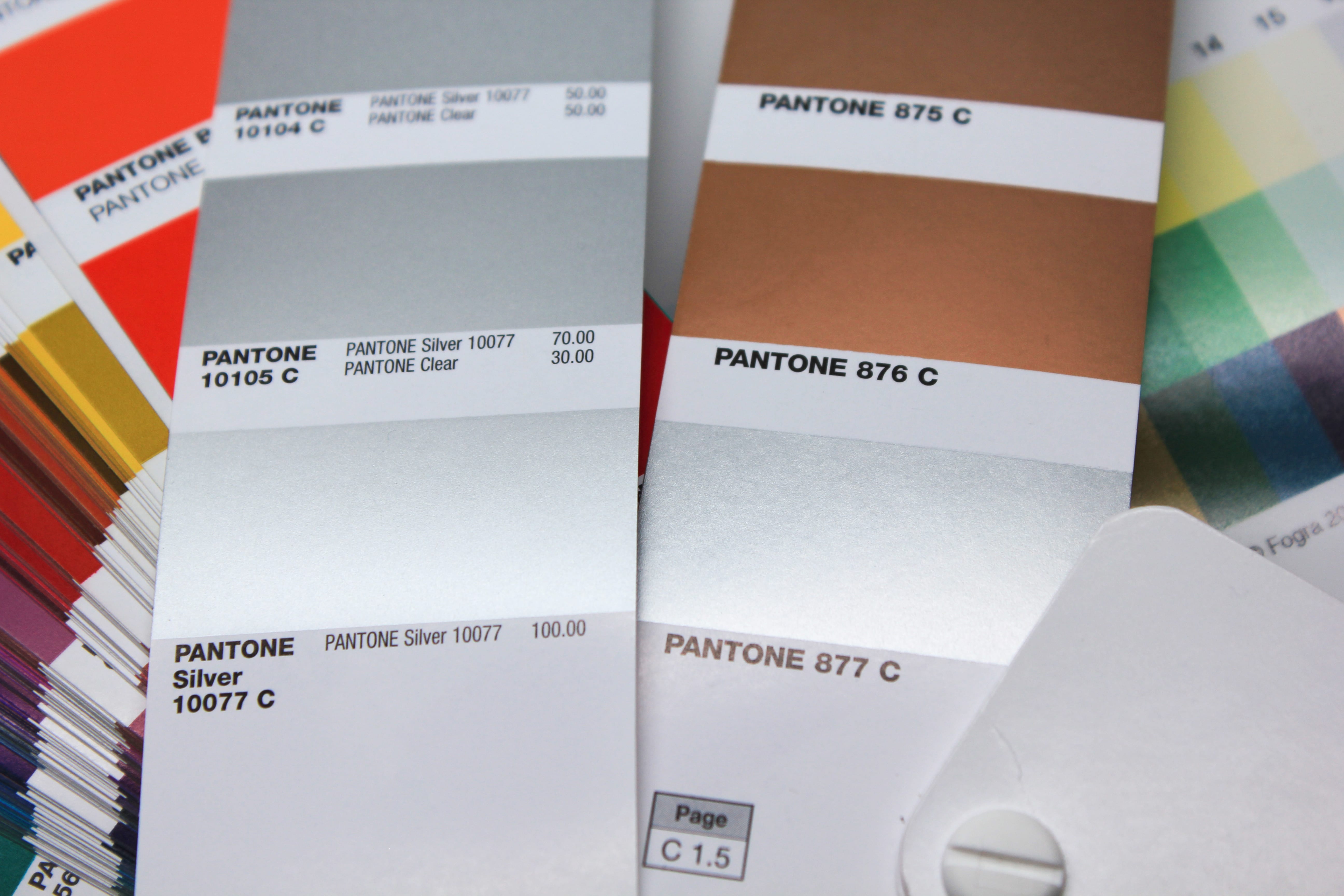
Currently, PANTONE has two parallel Metallics colour fans:
- PANTONE Metallics Coated: Contains the classic metallic shades available since the late 1980s.
- Main basic colours: PANTONE 877, 876, 875 …
- Typical colour names: PANTONE 8020, 8040, 8060, etc.
- PANTONE Premium Metallics Coated: The new Metallics fan, which has been in existence since 2012, showing new, finer metallic shades.
- Main basic colour: PANTONE Silver 10077 C
- Typical colour names: PANTONE 10142, 10158, 10214, etc.
The main differences between the two fans lie in the composition of their respective basic colours: Firstly, there is the different Pantone Silver: PANTONE 877 or PANTONE Silver 10077 C. On the other hand, in the PANTONE Metallics Coated the silver is supplemented by further gold basic colours, while in the PANTONE Premium Metallics Coated the newly defined silver is the only metallic basic colour and is tinted by PANTONE Goe basic colours.
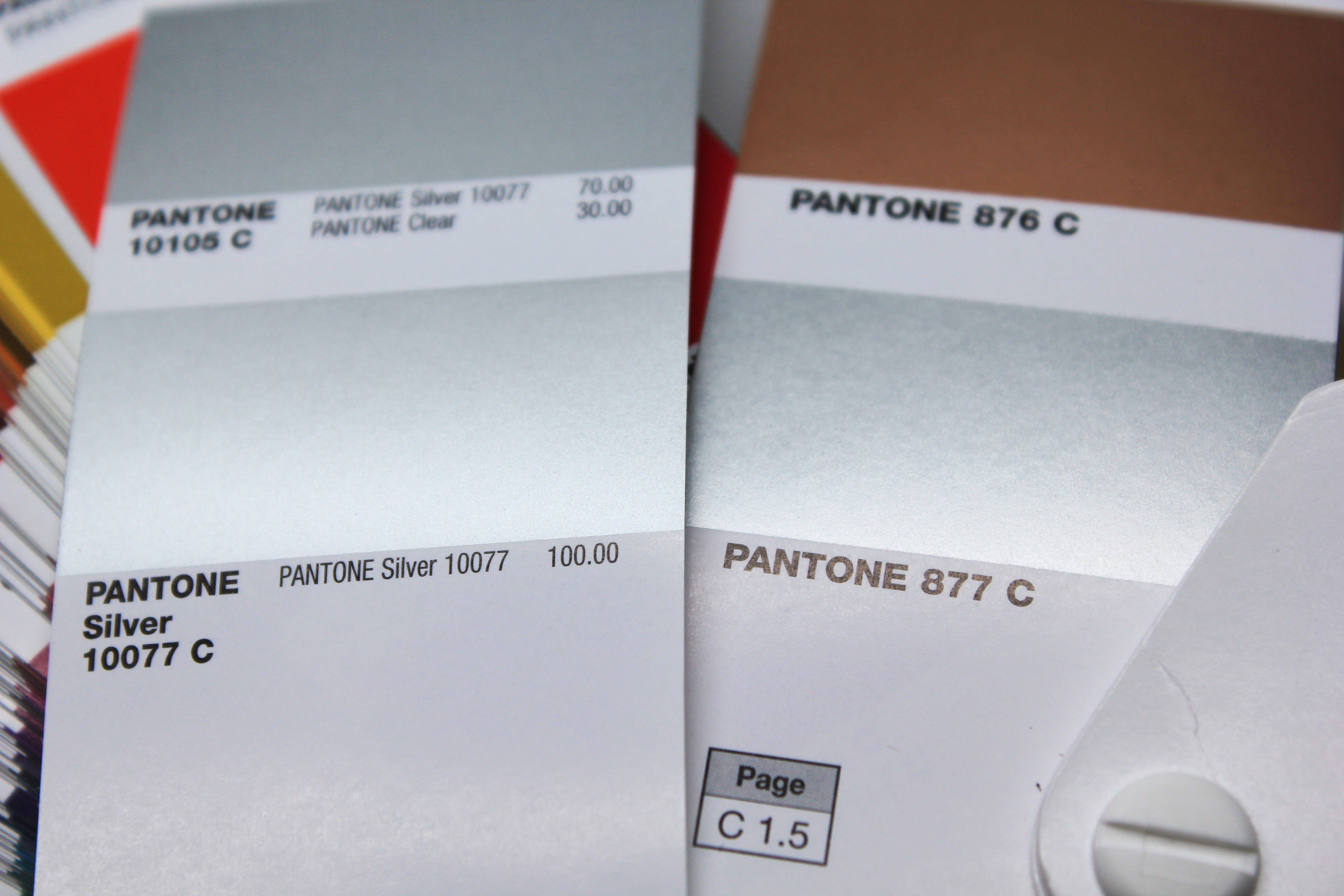
Pantone 877 and the gold inks contain metal flakes which, after the ink has dried on the paper, settle on the ink surface like leaves, creating a silver effect. This irregular surface structure can be very different and depends, among other things, on the drying time of the ink. As a result, the silver effect could vary from print to print. After varnishing, the silver effect was usually much weaker and less brilliant than before print finishing.
PANTONE Silver C(called PANTONE Silver 10077 C in the fan, but today mostly communicated by Pantone itself as PANTONE Silver C) consists of finely emulsified metal particles, which, in contrast to the metal flakes of the 877, are very evenly distributed on the paper due to the colour. The result is a more even, calm and brilliant silver surface that retains its shine and brilliance even after varnishing and is more stable in perspective than the previous colour. According to PANTONE, the durability of the ink has also been improved. The new silver is compatible with UV and water-based lacquers and can be laminated and foil embossed.
The Premium Metallics C colour fan from PANTONE shows colour reproduction with and without dispersion varnish. Important for printers: Due to the different composition, the manufacturer Eckhart recommends a different density: 1.0 for PANTONE 877 and only 0.7 for the new PANTONE Silver C, each measured with a polarized densitometer via the black filter.
One thing is not quite clear: The new 300 PANTONE Premium Metallics C colours are mixed from PANTONE Silver 10077 C and PANTONE Goe basic colours. However, GOE was discontinued in 2014. According to information from a Pantone employee, the colour shades will be converted to the 18 Pantone Matching System basic colours in a new fan generation – PANTONE Bright Orange (GOE) would then become PANTONE Orange 021 (PMS) as the basic colour. Since the basic colour is the same anyway, and has only differed in the thickness of the layer, this has no effect on the colourfulness.
Both PANTONE colour fans are stored as spot colours in our FIERY XF for the proof and can therefore be proofed as spot colours by Proof.de – in the context of the very poor proofability of metallic colours. As no metallic pigments are available for proofing, the silvery effect is only simulated by the velvety gloss of the proof paper. We use the EFI 4245 Gravure Proof Paper, which has a satin surface and allows a halfway decent silver simulation. However, a reasonable preview of the expected printing result is only possible in the PANTONE colour fan.
You can order PANTONE 877 or PANTONE Silver C Proofs here
More articles related to this topic:
We passed the first proof certification for the 7C proof under FOGRA55

A few days ago Proof GmbH was the first company to be certified for proofing for the new 7C exchange colour space FOGRA55. Fogra has developed characterisation data for extended multicolour printing with the printing colours CMYKOGV – i.e. cyan, magenta, yellow, black (contrast), orange, green and violet – FOGRA55 as part of a research project over the past few years. The characterisation data and the ICC profile Ref-ECG-CMYKOGV_FOGRA55_TAC300.icc have been published on the Fogra website in recent weeks. We have now carried out the certification via GMG ColorProof, as … read more
Incorrect grayscale display in Adobe Photoshop and InDesign

Adobe products are ideal for image retouching and layout and handle RGB and CMYK colour profiles very well. However, when editing and retouching grayscale images, for example for a black-and-white photo book, the experience is quite different. Suddenly, images look completely different in InDesign than they do in Photoshop, and even when exporting the image to PDF, greyscale images are suddenly treated differently. This article explains where the problems lie with black-and-white images and greyscale profiles in InDesign and Photoshop layouts, and how you can work in a more ‘colour-accurate’ … read more
“Digital First” often means “Colour Problems Second!”

Whether it’s a large global corporation or a small company, the following often applies to designs or redesigns today: we develop everything for digital first.
New edition of ISOCoatedV2 in M1 in sight?

Even almost 9 years after the introduction of the successor colour space PSOCoatedV3, ISOCoatedV2 / FOGRA39 is still the most widespread colour space in Europe. We at Proof GmbH count around 200 jobs from time to time for the German Printing and Media Industries Federation, among others. In the last count, proofs in ISOCoatedV2 accounted for around 68% of all proof jobs at our company. This is a clear sign of the continued widespread use of the colour space. ISOCoatedV2: From the classic colour space to the beacon of the … read more
MYIRO-9: New Spectrophotometer from KonicaMinolta in action

Over the last few months, we at Proof.de have been thinking about further improving our already very good colour measurement technology in terms of speed and measurement precision. Relatively quickly it became clear that only two devices would come into question: The KonicaMinolta MYIRO-9, the successor of the former FD-9, or the X-Rite ISIS 2 XL. The starting point: Since we at Proof GmbH have 5 proofing devices, the calibration of targets for profile optimisation is a time-critical undertaking for us. Therefore, we had been looking around for an upgrade of … read more
Proof.de is featured twice in the “Fogra Aktuell” magazine

In the current issue of Fogra News “Fogra Aktuell” Proof GmbH is involved in two places. Firstly, a summary of the Fogra report on our first FOGRA55 certification for seven-colour printing with extended colour space in CMYKOGV appeared. You can also find more information on our FOGRA55 certification on the Fogra website: https://fogra.org/en/press-releases/fogracert-erste-cpc-zertifizierung-fuer-fogra55-cmykogv-330 and on proofing.de: And secondly, there was a report on the completion of the research project for textile digital printing, FOGRA58, in which we were allowed to investigate and test the proof capability of the new textile … read more
Fogra Colour Management Symposium 2026 in Munich from 24 to 26 February

The most important colour management event takes place every two years in Munich: the Fogra Colour Management Symposium. Once again this year, all professionals are invited to make the pilgrimage to Munich: two days of lectures, discussions and a Bavarian evening await participants. Matthias Betz, owner of proof.de, will also be there again: for many years, he has been taking advantage of the opportunity to exchange ideas with colleagues and friends, learn about new technologies, hardware and software, and talk to colleagues from Fogra, freieFarbe, GMG and many more. In … read more
New feature: Orders & individual items can now be reordered with a single click

From now on, it’s much easier and faster: in the Proof Shop, you can call up and reorder entire orders or individual proofs directly from your order history. This saves you from having to re-enter every detail and gives you the assurance that all settings will be exactly the same as last time. With just a few clicks, your proofs are reordered – reliably, easily and in no time at all. What exactly is new? You can find your order history in your customer account. There are two new options … read more
PANTONE surveys users online about product and service direction

Today I received an email in which PANTONE asked how it should orientate its products and services in the future. The users were asked which countries, industries and company sizes they come from, but also what PANTONE products should look like in the future and what customers would be prepared to pay for PANTONE services in the future. Question: How much can PANTONE services cost? PANTONE appears to be orientating itself on the PANTONE Connect prices: All price queries have the lowest price category < $ 7,- / month, i.e. … read more
New certified proof papers at proof.de

In recent years, various problems have arisen with our previous proof paper supplier. On the one hand, we sometimes had to wait more than three months for paper deliveries; on the other hand, we sometimes had significant problems with batch-to-batch discrepancies, surface defects and much more. After lengthy deliberations, we decided in December to replace all the paper. We therefore received pallets of new paper at the turn of the year, which we are now gradually incorporating into our production. There will be no hard cut, but the new papers … read more