
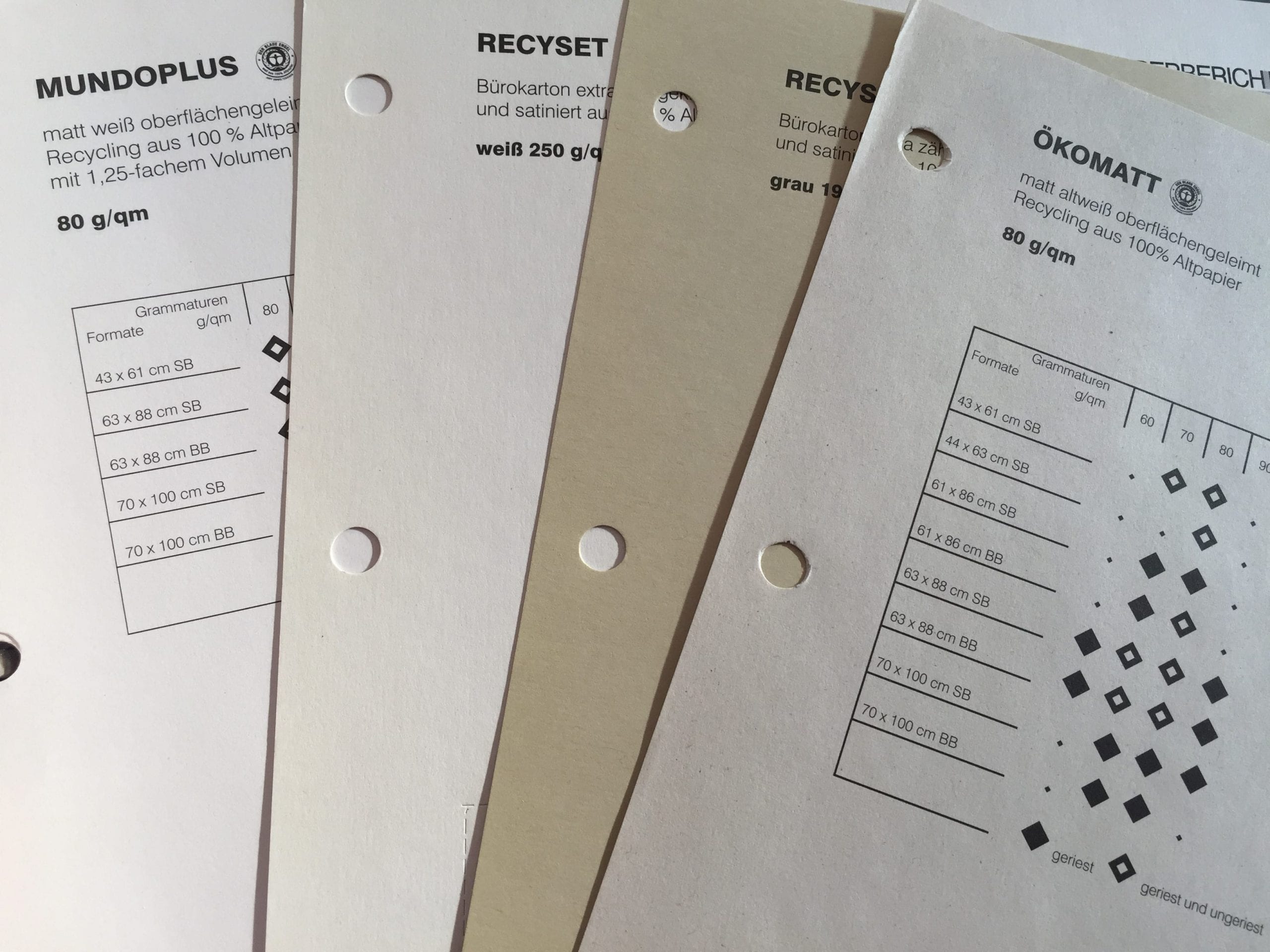
We produce proofs for classic white uncoated papers on a daily basis, but the question often arises as to which proof standard could be used for printing on recycled paper.
In general, the paper white in a proof is precisely defined in the proof standard and is also measured in every test report.
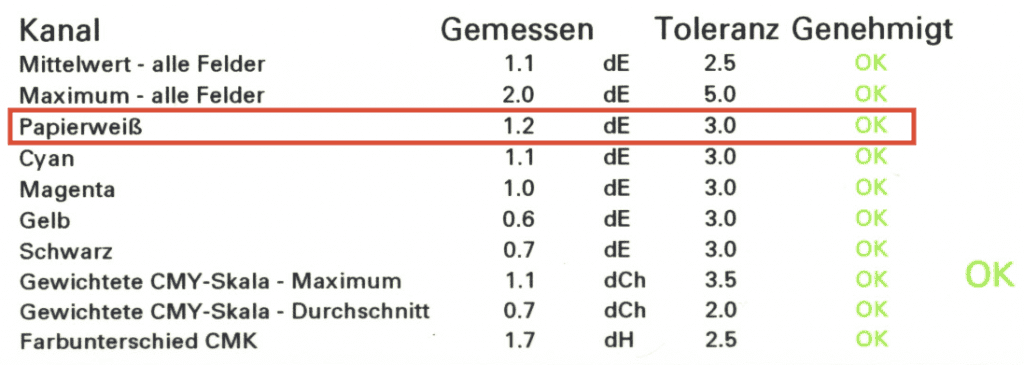
For PSOUncoated it is 95.00 / 0.00 / -2.00 in CIELAB and for PSOUncoatedV3 it is 93.50 / 2.50 / -10.00, i.e. slightly darker (93.50 instead of 95.00 for brightness L) and significantly bluer (-10.00 instead of -2.00 on the B axis, i.e. the blue-yellow axis in the blue direction).
Recycling papers differ not only greatly from type to type in the area of paper white, but even from batch to batch. So if a printing company orders the same recycling paper in January and in February, the paper mill may well deliver a slightly different white value of the paper, as the paper white of course depends strongly on the recycled paper qualities used for production.
-
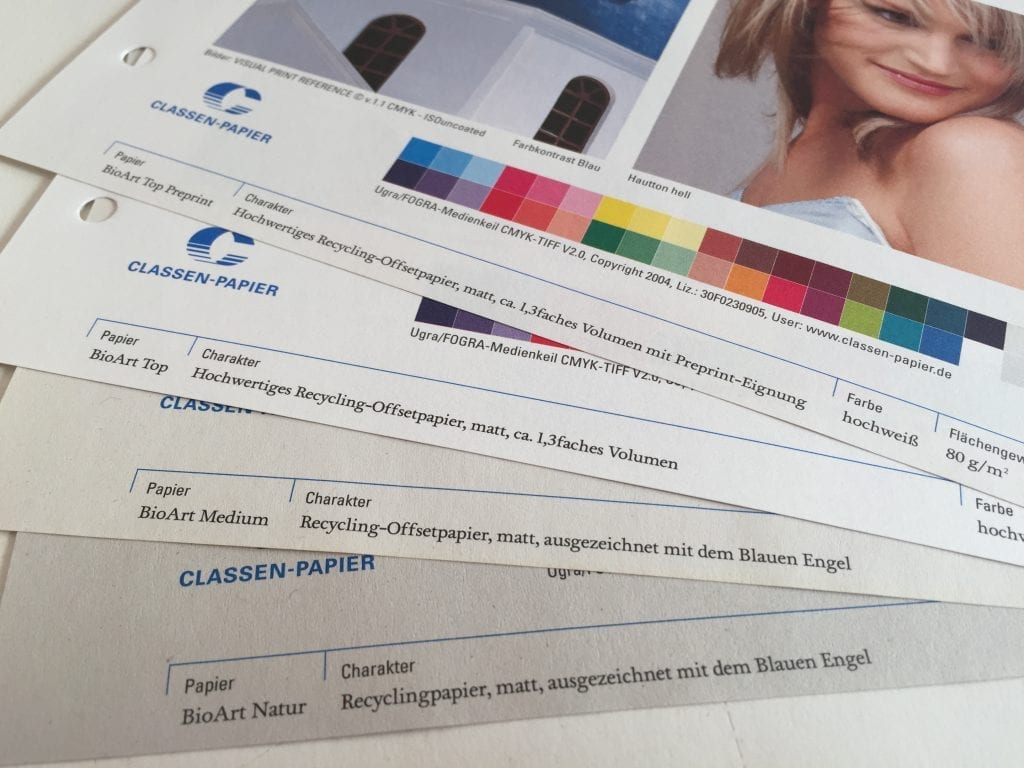
Recycling papers
White-point sample 1 -
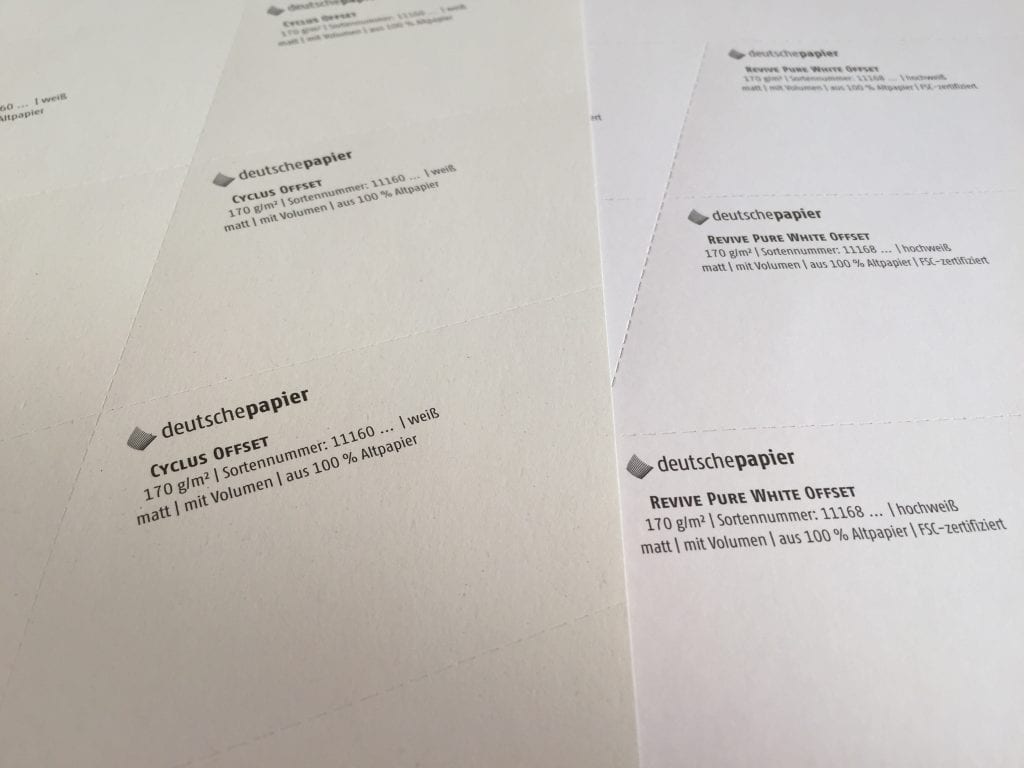
Recycling papers
White-point sample 2 -
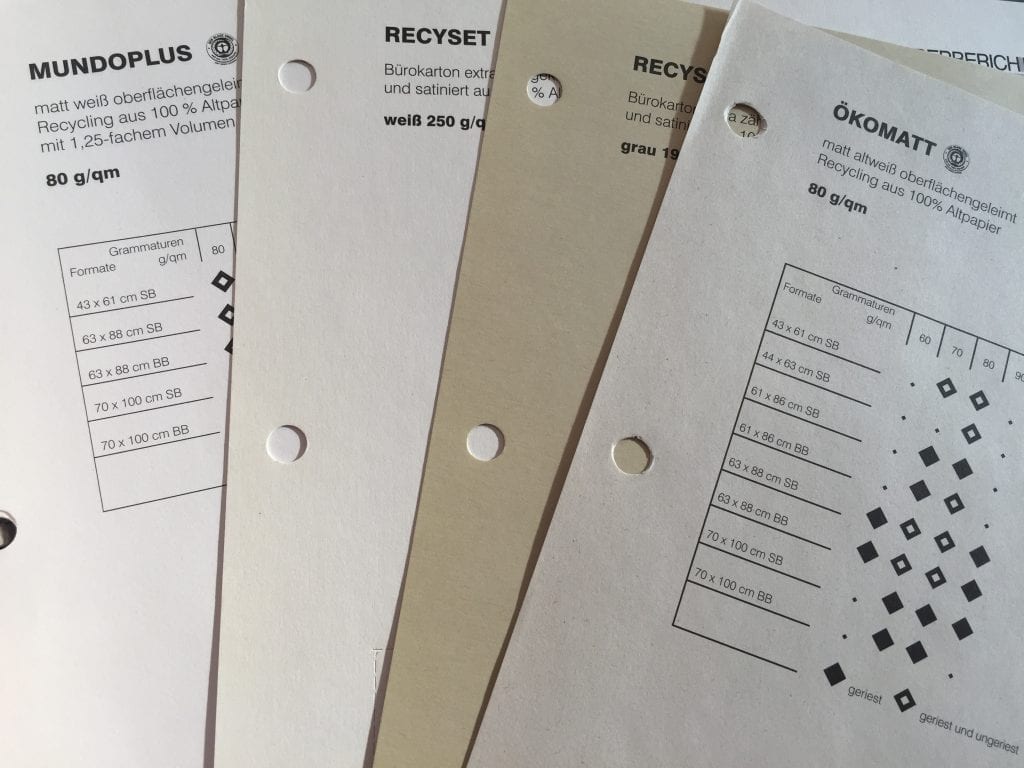
Recycling papers
White-point sample 2
A colour-binding proof for recycling paper is therefore not possible, as no standard has ever been worked out due to the different paper qualities and white tones.
It is recommended for the proof to choose a classic proof standard such as PSOUncoated / Fogra 47, which shows a rather neutral, unbrightened paper white in the proof. Place one side of the recycled paper next to the proof and mentally transfer the colour of the proof to the white tone of your recycled paper. This way you can imagine the later printing result quite well.
More articles related to this topic:
New edition of ISOCoatedV2 in M1 in sight?

Even almost 9 years after the introduction of the successor colour space PSOCoatedV3, ISOCoatedV2 / FOGRA39 is still the most widespread colour space in Europe. We at Proof GmbH count around 200 jobs from time to time for the German Printing and Media Industries Federation, among others. In the last count, proofs in ISOCoatedV2 accounted for around 68% of all proof jobs at our company. This is a clear sign of the continued widespread use of the colour space. ISOCoatedV2: From the classic colour space to the beacon of the … read more
Colour deviations in 2023 PANTONE Color Bridge Guides

After Eddy Hagen pointed out in this posts, that there were some major colour deviations between the brand new PANTONE Solid Coated Guide 2023 and the previous version especially for the PANTONE 2635 C, I was curious to lookup the same colours in the new PANTONE Color Bridge Coated Guide of 2023 and compare the colours with the previous version. I measured a dE00 of 8,15 between the two colours that Eddy mentioned, which is really far apart from how accurate PANTONE colours should match between the different PANTONE guides. … read more
Proof.de is featured twice in the “Fogra Aktuell” magazine

In the current issue of Fogra News “Fogra Aktuell” Proof GmbH is involved in two places. Firstly, a summary of the Fogra report on our first FOGRA55 certification for seven-colour printing with extended colour space in CMYKOGV appeared. You can also find more information on our FOGRA55 certification on the Fogra website: https://fogra.org/en/press-releases/fogracert-erste-cpc-zertifizierung-fuer-fogra55-cmykogv-330 and on proofing.de: And secondly, there was a report on the completion of the research project for textile digital printing, FOGRA58, in which we were allowed to investigate and test the proof capability of the new textile … read more
“Digital First” often means “Colour Problems Second!”

Whether it’s a large global corporation or a small company, the following often applies to designs or redesigns today: we develop everything for digital first.
Cross-media colour management really works

Peter Jäger is an expert in colour management that reliably works across the boundaries of printers and monitors, web and print – essentially: cross-media.
PANTONE surveys users online about product and service direction

Today I received an email in which PANTONE asked how it should orientate its products and services in the future. The users were asked which countries, industries and company sizes they come from, but also what PANTONE products should look like in the future and what customers would be prepared to pay for PANTONE services in the future. Question: How much can PANTONE services cost? PANTONE appears to be orientating itself on the PANTONE Connect prices: All price queries have the lowest price category < $ 7,- / month, i.e. … read more
We passed the first proof certification for the 7C proof under FOGRA55

A few days ago Proof GmbH was the first company to be certified for proofing for the new 7C exchange colour space FOGRA55. Fogra has developed characterisation data for extended multicolour printing with the printing colours CMYKOGV – i.e. cyan, magenta, yellow, black (contrast), orange, green and violet – FOGRA55 as part of a research project over the past few years. The characterisation data and the ICC profile Ref-ECG-CMYKOGV_FOGRA55_TAC300.icc have been published on the Fogra website in recent weeks. We have now carried out the certification via GMG ColorProof, as … read more
Proofs with Digimarc EAN codes and verification

Digimarc is a digital watermark that can be used to embed information in images, videos or other media. Digimarc watermarks are invisible to the human eye, but remain recognisable to special software or devices. Digimarc is becoming increasingly popular in the packaging sector in particular, as this technology allows the digits of the EAN barcode and more to be applied invisibly to all areas of the packaging. Digimarc and EAN barcode at the supermarket checkout When scanning at the checkout, the checkout staff do not have to search for the … read more
RGB colour spaces explained

RGB colour spaces are colour systems that represent different hues with the three primary colours red, green and blue. RGB colour spaces are used in digital image processing, photography and computer technology to precisely define colours. The most important RGB colour spaces and their special features are: sRGB sRGB is the most widely used RGB colour space and is used by most monitors, printers and digital cameras. It was developed by HP and Microsoft in the 1990s to create a standard for colour representation on the internet and on various … read more
X-Rite i1Profiler no longer supports i1Pro2 and i1iO 2

Anyone who has reinstalled or updated their i1 Profiler app in the last few weeks has been confronted with disturbing news: X-Rite announced directly in the start window that it would no longer support its enormously popular i1Display and i1Pro2 devices. Users of the i1Pro 2 devices and i1iO 2 tables, which are extremely popular in printing and colour management, will be particularly hard hit by the announcement: An investment of €6,000 is quickly consigned to the electronic scrap heap. But what can you do if you own such a … read more