
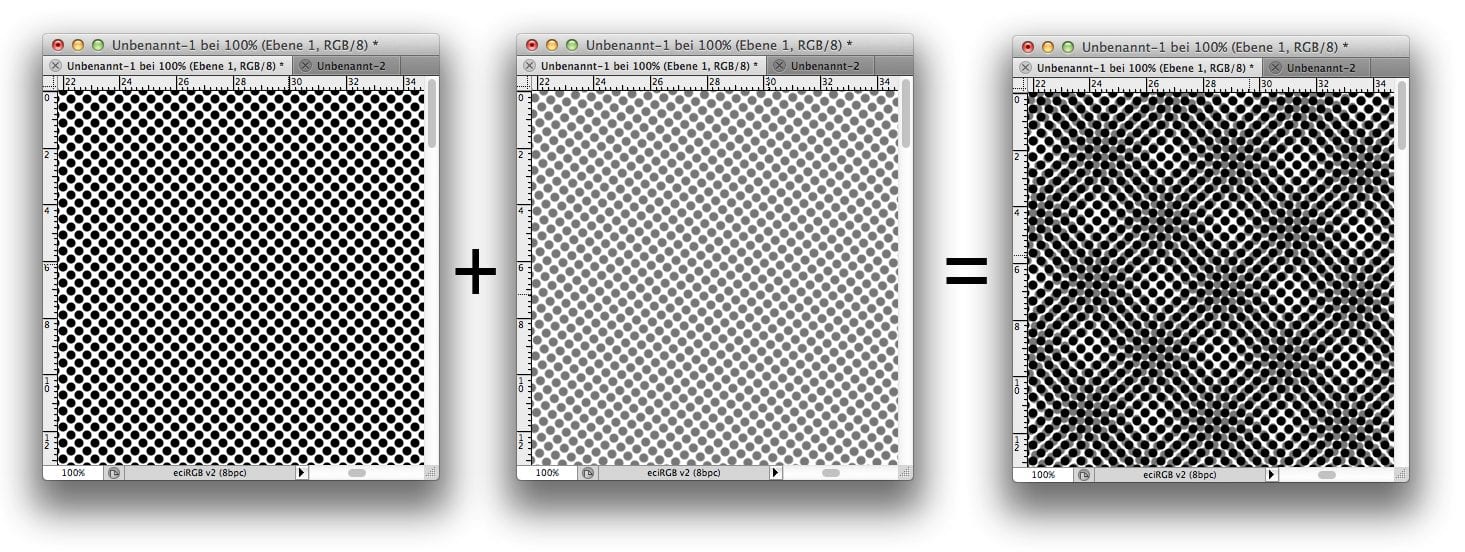
The Moiré effect, or in other words a halftone screen overlay, is a common phenomenon when viewing prints. It occurs when two even patterns overlap unevenly.
When does Moiré appear?
Moire is always created when screens overlap. Typical examples:
- You have scanned in a newspaper ad and print it in another newspaper.
- You print the portrait of a managing director wearing a jacket with a fine houndstooth pattern, a checkered shirt and a finely patterned tie. Regardless of the printing process, complete moiré chaos is guaranteed to break out here.
- A brick building is reproduced in offset printing.
- The photograph of a ventilation grille is viewed on a monitor
No Moiré occurs when:
- The motif is printed large enough, e.g. on a trade fair wall, so that no grid overlapping occurs. The print screen is sufficiently fine to reproduce the image screen completely.
- The motif is printed small enough so that no screen overlay occurs. If the check shirt is printed so small that no more check can be reproduced, Moiré will no longer appear.
- Printed in a frequency modulated screen. If the screen is distributed seemingly chaotically over the page, the chance of an overlay is significantly minimized.
You will find numerous examples of Moiré images in the Google image search. Particularly exciting: checkered shirts in different magnification levels. Have a look and search!
For the most part, moiré cannot be checked in a proof.
All common proofing systems concentrate on the reproduction of colours during proofing, but not on the reproduction of the typical offset screen and offset rosette. Why is that?
Printers work with different screen widths and screen angles. From 54 to 80 screens in sheetfed offset to 32 screens in newspaper printing, there are many screens on the market. Sometimes the screen dot is round, sometimes square, sometimes diamond-shaped. In addition, the screen angle of CMYK and spot colours also varies from printer to printer. And some printing companies also print a frequency-modulated screen that is not subject to screen angles but is produced practically randomly by the RIP. As a result, proofing companies mainly concentrate on the reproduction of colours, but not of screens and offset rosettes.
The most common proofs are produced as detailed as possible in inkjet printing without raster reproduction. In addition, proofing software manufacturers often use other calculation algorithms to make the proofs look more realistic. While in practice EFI proofs often look much fuzzier than modern offset prints printed via CTP, GMG uses artificial noise to make its proofs “look bad” and thus possibly better match the printed result. It remains to be seen whether this is useful and effective, but it also leads even further away from a recognizable Moiré.
Reliably detecting Moiré is expensive.
The only way to reliably predict possible Moiré is a press proof according to the precisely identical screen and screen angle specifications of the printer who prints the run, i.e. optimally a press proof at the same printer with the same prepress and on the same press on which the final print will later run. This is expensive, but it accurately shows the final print.
A test print at Flyeralarm is no solution.
Although Flyeralarm mainly prints the supplied data in a very high quality and accurate way, screen spacing and screen angle are certainly not identical to those of the local printing house. The Moiré at Flyeralarm is therefore certainly not comparable with that of the local printing house.

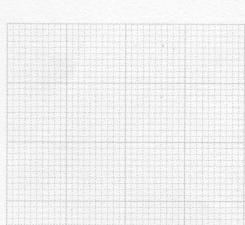
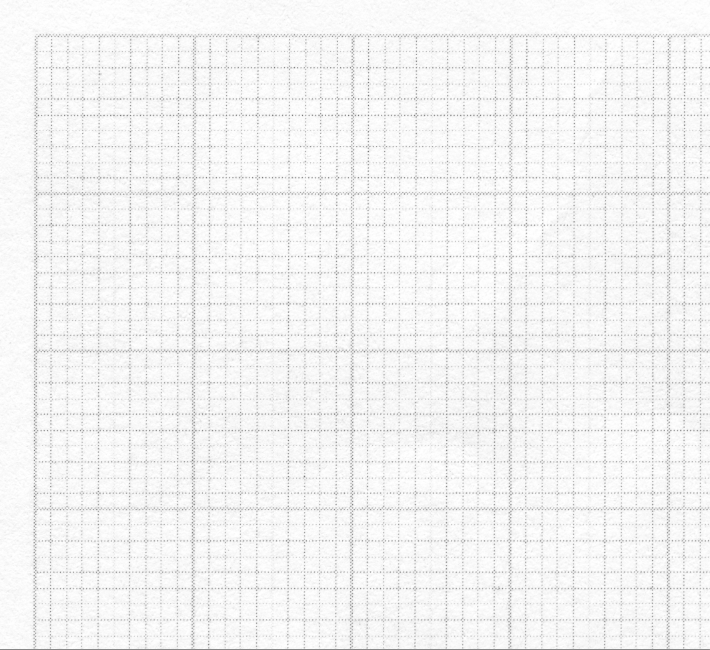
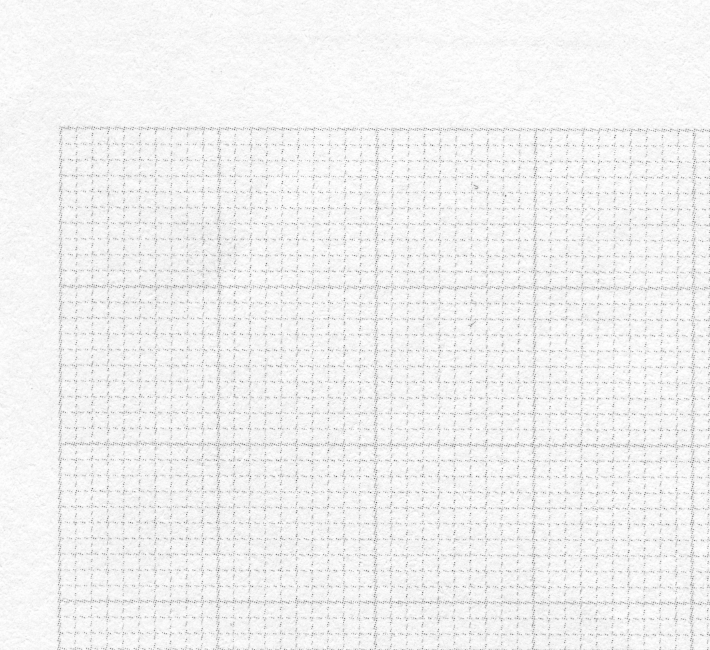
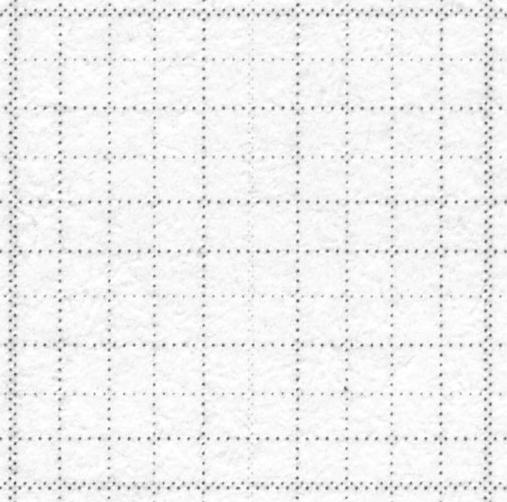
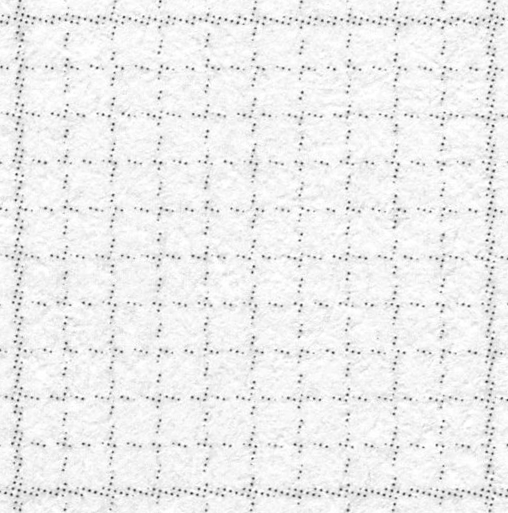
We recently had a very exciting example at hand. A notepad was printed with a millimetre grid in screened black. Picture 1 on the left shows the millimetre grid with a 45° screen angle in black and a 70 screen. Sometimes vertical lines are missing and at the bottom horizontal lines are completely missing due to the screen overlay. Figure 2 on the right shows the same millimetre grid with 15° grid angle in an 80 screen. The millimetre grid is reproduced evenly.
Both notepads were produced on the same day in the same printing company.
Interestingly, the repro company that produced the printing plates had manually changed the print screen from 15° to 45° for the first set of plates on the left because they thought it would give the best result. However, the unsatisfactory result was immediately apparent during the press proof. A notepad with missing lines will certainly not be accepted by the customer. After resetting to the original screen angle of 15° and increasing the screen from 70 to 80, a harmonious reproduction of the millimetre screen could be achieved without difficulty.
Below are the two excerpts in more detail:
More articles related to this topic:
“Digital First” often means “Colour Problems Second!”

Whether it’s a large global corporation or a small company, the following often applies to designs or redesigns today: we develop everything for digital first.
PANTONE surveys users online about product and service direction

Today I received an email in which PANTONE asked how it should orientate its products and services in the future. The users were asked which countries, industries and company sizes they come from, but also what PANTONE products should look like in the future and what customers would be prepared to pay for PANTONE services in the future. Question: How much can PANTONE services cost? PANTONE appears to be orientating itself on the PANTONE Connect prices: All price queries have the lowest price category < $ 7,- / month, i.e. … read more
New edition of ISOCoatedV2 in M1 in sight?

Even almost 9 years after the introduction of the successor colour space PSOCoatedV3, ISOCoatedV2 / FOGRA39 is still the most widespread colour space in Europe. We at Proof GmbH count around 200 jobs from time to time for the German Printing and Media Industries Federation, among others. In the last count, proofs in ISOCoatedV2 accounted for around 68% of all proof jobs at our company. This is a clear sign of the continued widespread use of the colour space. ISOCoatedV2: From the classic colour space to the beacon of the … read more
Incorrect grayscale display in Adobe Photoshop and InDesign

Adobe products are ideal for image retouching and layout and handle RGB and CMYK colour profiles very well. However, when editing and retouching grayscale images, for example for a black-and-white photo book, the experience is quite different. Suddenly, images look completely different in InDesign than they do in Photoshop, and even when exporting the image to PDF, greyscale images are suddenly treated differently. This article explains where the problems lie with black-and-white images and greyscale profiles in InDesign and Photoshop layouts, and how you can work in a more ‘colour-accurate’ … read more
Annual Conference of the German Society for Colour Science in Darmstadt

Having missed last year’s annual conference in Dresden at the last minute due to illness, I am all the more delighted to be attending this year’s event in Darmstadt. The programme is once again very exciting and varied! I’m particularly looking forward to Dr Andreas Kraushaar’s workshop ‘Measuring in Images’, the HDR lecture by Prof. Dipl.-Ing. Florian Süßl, and the insights into ‘Perzabsolut’ from Dr Moritz Feil. As we discovered at the last Colour Management Symposium in Munich, Moritz Feil – whilst working at the Technical University of Munich – … read more
RGB colour spaces explained

RGB colour spaces are colour systems that represent different hues with the three primary colours red, green and blue. RGB colour spaces are used in digital image processing, photography and computer technology to precisely define colours. The most important RGB colour spaces and their special features are: sRGB sRGB is the most widely used RGB colour space and is used by most monitors, printers and digital cameras. It was developed by HP and Microsoft in the 1990s to create a standard for colour representation on the internet and on various … read more
New PANTONE Formula Guides with incorrect ink formulations

Several errors have crept into the new PANTONE 2023 fan decks. In both the PANTONE Solid Coated and the Solid Uncoated color fans, there are colours for which the new ink formulations are incorrect. In the PANTONE Formula Guide Solid Coated fan 2023, PANTONE 107 C and PANTONE 108 C have absolutely identical ink recipes, as well as PANTONE 113 C and PANTONE 114 C. As the colors differ, this cannot be the correct. Several errors in the PANTONE Solid Uncoated fan 2023 In the PANTONE Solid Uncoated fan 2023 … read more
MYIRO-9: New Spectrophotometer from KonicaMinolta in action

Over the last few months, we at Proof.de have been thinking about further improving our already very good colour measurement technology in terms of speed and measurement precision. Relatively quickly it became clear that only two devices would come into question: The KonicaMinolta MYIRO-9, the successor of the former FD-9, or the X-Rite ISIS 2 XL. The starting point: Since we at Proof GmbH have 5 proofing devices, the calibration of targets for profile optimisation is a time-critical undertaking for us. Therefore, we had been looking around for an upgrade of … read more
New in the Proof Shop: Separate invoice email

At long last, we are able to fulfil a request made by many of our customers: from now on, you can register two email addresses in the Proof Shop – one for logging in and receiving status or tracking emails, and a separate one solely for receiving digital PDF invoices. Over the past few years, we have already switched many Proof customers to digital invoicing at their request, i.e. we generated a PDF invoice and then sent it manually to a second email address on file with us in the … read more
Fogra Colour Management Symposium 2026 in Munich from 24 to 26 February

The most important colour management event takes place every two years in Munich: the Fogra Colour Management Symposium. Once again this year, all professionals are invited to make the pilgrimage to Munich: two days of lectures, discussions and a Bavarian evening await participants. Matthias Betz, owner of proof.de, will also be there again: for many years, he has been taking advantage of the opportunity to exchange ideas with colleagues and friends, learn about new technologies, hardware and software, and talk to colleagues from Fogra, freieFarbe, GMG and many more. In … read more