
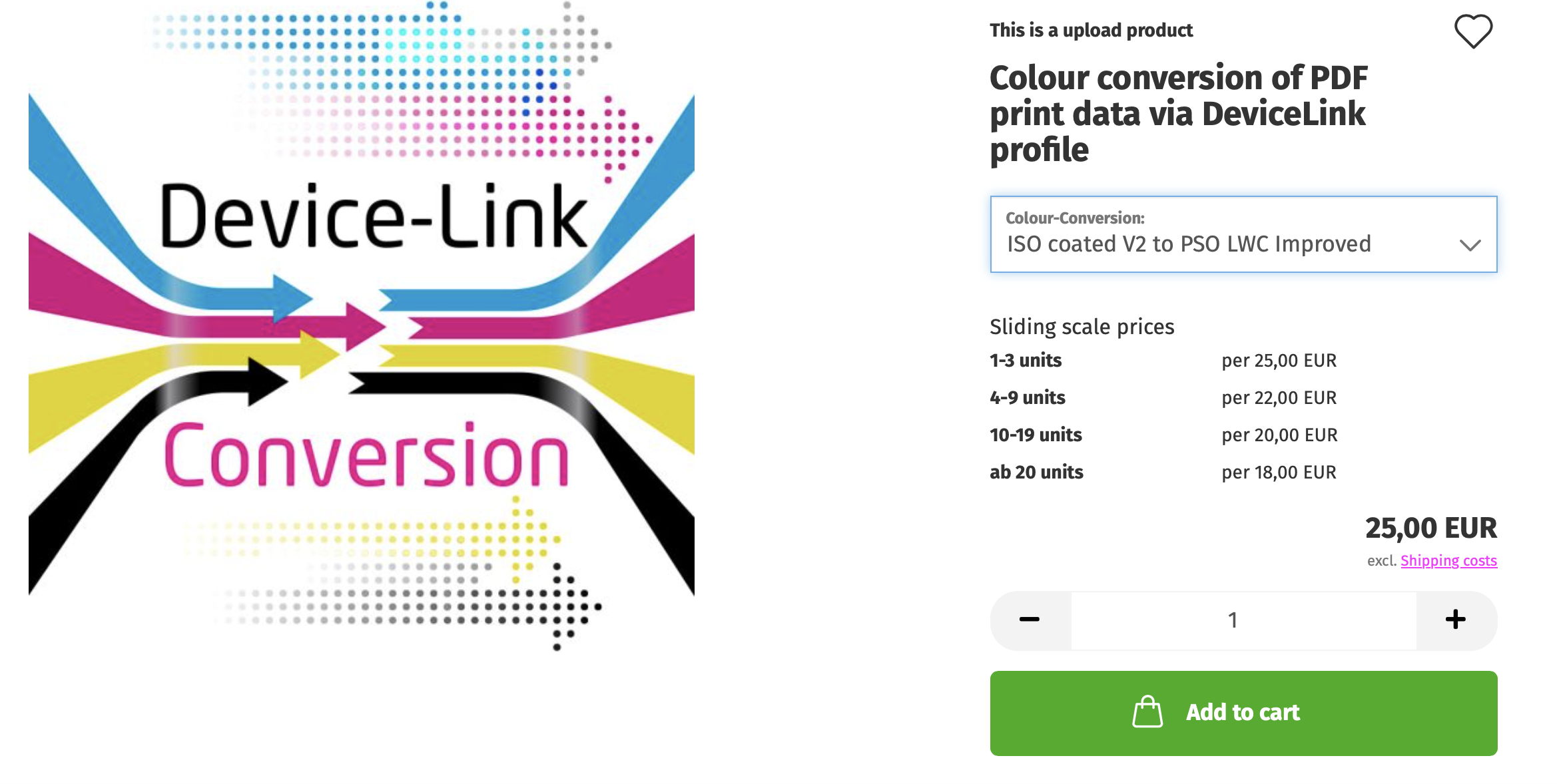
A DeviceLink conversion is a colour management process in which a direct colour transformation is carried out between two specific colour profiles. In contrast to conventional profile conversion, in which a source profile is converted into a working profile such as a Profile Connection Space (PCS, usually LAB) and then into a target profile, DeviceLink conversion enables colour information to be transferred directly between two colour profiles without taking the diversions via a PCS.
A DeviceLink conversion offers more control and precision as it is specifically optimised for colour transformation between two specific colour spaces. Primary colours and secondary colours are usually retained, but the colour information required for an exact match between the devices is taken into account and other aspects of colour management such as colour space or rendering intents are neglected.
This type of conversion is particularly useful when colour reproduction between certain devices is critical, e.g. when transferring print data for advertisements in different media. For example, when a TV station launches a new series, adverts have to appear in media with a wide variety of printing processes. Sometimes in newspaper printing, sometimes in offset, sometimes in gravure printing, which often creates difficulties for the agency producing the adverts. The solution is to create all ads in their original colour space such as ISOCoatedV2 and simply adjust the sizes of the ads, and then have a service provider convert them into the different target colour spaces via DeviceLink.
Proof GmbH as DeviceLink conversion service provider and proof service provider then receives the order to convert different advertisements differently via DeviceLink, to subsequently proof the converted data in the target colour space, and then to deliver proofs and DeviceLink-converted PDF data to the customer for onward dispatch to the various magazines and newspapers.
DeviceLink conversions are carried out with special software tools, colour servers or colour management solutions that support this function. A DeviceLink profile is created that enables a direct colour transformation between the two device profiles. This DeviceLink profile can then be used to convert colours between the corresponding devices precisely and efficiently. Proof GmbH relies on DeviceLinks from ColorLogic, a manufacturer that offers optimum expertise in the conversion of colour spaces.
DeviceLink conversions are a colour management technique that requires special knowledge and experience. They should be applied and tested carefully in order to achieve the desired results and avoid undesirable effects. Before you make faulty DeviceLink conversions yourself, you should rely on specialists.
In the Proof GmbH shop you can order DeviceLink PDF file conversions directly, which are carried out with DeviceLink profiles from Colorlogic
More articles related to this topic:
We passed the first proof certification for the 7C proof under FOGRA55

A few days ago Proof GmbH was the first company to be certified for proofing for the new 7C exchange colour space FOGRA55. Fogra has developed characterisation data for extended multicolour printing with the printing colours CMYKOGV – i.e. cyan, magenta, yellow, black (contrast), orange, green and violet – FOGRA55 as part of a research project over the past few years. The characterisation data and the ICC profile Ref-ECG-CMYKOGV_FOGRA55_TAC300.icc have been published on the Fogra website in recent weeks. We have now carried out the certification via GMG ColorProof, as … read more
Proof GmbH 2025 once again Fogra and Fogra “Spot Cert” certified

This year we once again created proofs for Fogra certification and sent them to Munich-Aschheim for testing. With these proof prints, which we print according to three different proof standards and on three different papers, we point out that we not only deliver excellent proof quality through internal quality controls and checks, but that the quality of our proofs is also measured and confirmed by external experts. We have now had test prints certified by Fogra for the 12th time. We have also been “Spot-cert” certified for the display of … read more
X-Rite i1Profiler no longer supports i1Pro2 and i1iO 2

Anyone who has reinstalled or updated their i1 Profiler app in the last few weeks has been confronted with disturbing news: X-Rite announced directly in the start window that it would no longer support its enormously popular i1Display and i1Pro2 devices. Users of the i1Pro 2 devices and i1iO 2 tables, which are extremely popular in printing and colour management, will be particularly hard hit by the announcement: An investment of €6,000 is quickly consigned to the electronic scrap heap. But what can you do if you own such a … read more
New feature: Orders & individual items can now be reordered with a single click

From now on, it’s much easier and faster: in the Proof Shop, you can call up and reorder entire orders or individual proofs directly from your order history. This saves you from having to re-enter every detail and gives you the assurance that all settings will be exactly the same as last time. With just a few clicks, your proofs are reordered – reliably, easily and in no time at all. What exactly is new? You can find your order history in your customer account. There are two new options … read more
Proof.de is featured twice in the “Fogra Aktuell” magazine

In the current issue of Fogra News “Fogra Aktuell” Proof GmbH is involved in two places. Firstly, a summary of the Fogra report on our first FOGRA55 certification for seven-colour printing with extended colour space in CMYKOGV appeared. You can also find more information on our FOGRA55 certification on the Fogra website: https://fogra.org/en/press-releases/fogracert-erste-cpc-zertifizierung-fuer-fogra55-cmykogv-330 and on proofing.de: And secondly, there was a report on the completion of the research project for textile digital printing, FOGRA58, in which we were allowed to investigate and test the proof capability of the new textile … read more
Proofs with Digimarc EAN codes and verification

Digimarc is a digital watermark that can be used to embed information in images, videos or other media. Digimarc watermarks are invisible to the human eye, but remain recognisable to special software or devices. Digimarc is becoming increasingly popular in the packaging sector in particular, as this technology allows the digits of the EAN barcode and more to be applied invisibly to all areas of the packaging. Digimarc and EAN barcode at the supermarket checkout When scanning at the checkout, the checkout staff do not have to search for the … read more
Incorrect grayscale display in Adobe Photoshop and InDesign

Adobe products are ideal for image retouching and layout and handle RGB and CMYK colour profiles very well. However, when editing and retouching grayscale images, for example for a black-and-white photo book, the experience is quite different. Suddenly, images look completely different in InDesign than they do in Photoshop, and even when exporting the image to PDF, greyscale images are suddenly treated differently. This article explains where the problems lie with black-and-white images and greyscale profiles in InDesign and Photoshop layouts, and how you can work in a more ‘colour-accurate’ … read more
Fogra Colour Management Symposium 2026 in Munich from 24 to 26 February

The most important colour management event takes place every two years in Munich: the Fogra Colour Management Symposium. Once again this year, all professionals are invited to make the pilgrimage to Munich: two days of lectures, discussions and a Bavarian evening await participants. Matthias Betz, owner of proof.de, will also be there again: for many years, he has been taking advantage of the opportunity to exchange ideas with colleagues and friends, learn about new technologies, hardware and software, and talk to colleagues from Fogra, freieFarbe, GMG and many more. In … read more
New certified proof papers at proof.de

In recent years, various problems have arisen with our previous proof paper supplier. On the one hand, we sometimes had to wait more than three months for paper deliveries; on the other hand, we sometimes had significant problems with batch-to-batch discrepancies, surface defects and much more. After lengthy deliberations, we decided in December to replace all the paper. We therefore received pallets of new paper at the turn of the year, which we are now gradually incorporating into our production. There will be no hard cut, but the new papers … read more
New edition of ISOCoatedV2 in M1 in sight?

Even almost 9 years after the introduction of the successor colour space PSOCoatedV3, ISOCoatedV2 / FOGRA39 is still the most widespread colour space in Europe. We at Proof GmbH count around 200 jobs from time to time for the German Printing and Media Industries Federation, among others. In the last count, proofs in ISOCoatedV2 accounted for around 68% of all proof jobs at our company. This is a clear sign of the continued widespread use of the colour space. ISOCoatedV2: From the classic colour space to the beacon of the … read more